
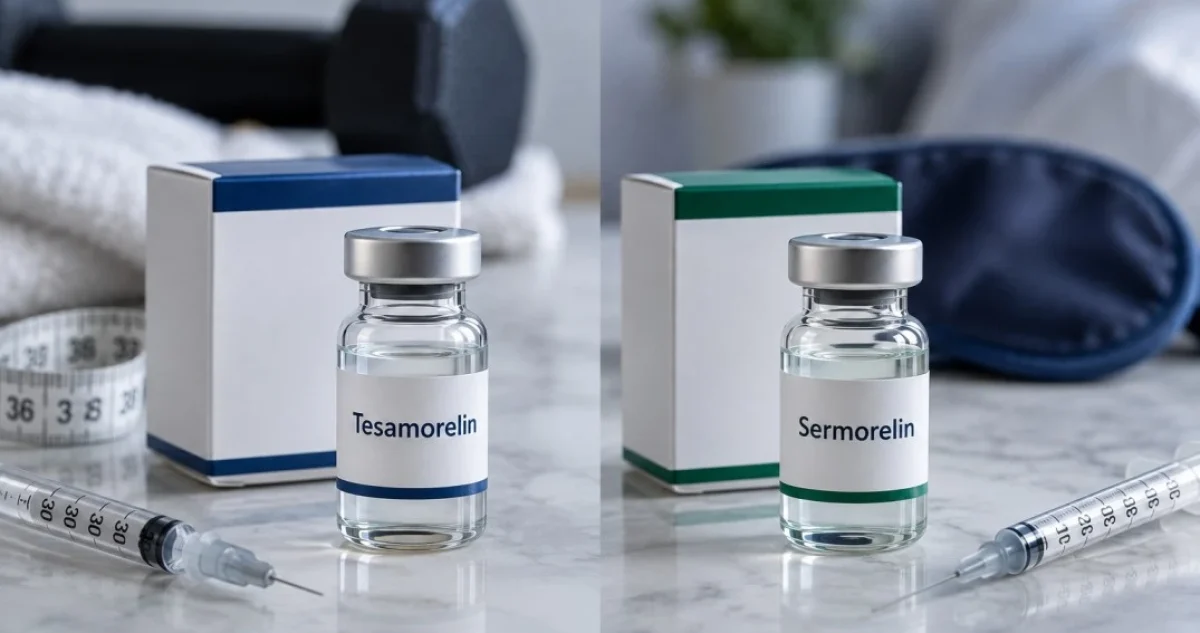
Deciding between tesamorelin vs sermorelin is one that telehealth companies evaluating body composition protocols encounter regularly. Their distinctions carry meaningful clinical and regulatory weight.
Understanding the difference between sermorelin vs tesamorelin requires examining each compound at the molecular level, across regulatory status, and through the lens of compounding pharmacy involvement. This comparison covers the above in detail.
What Are Tesamorelin and Sermorelin?
Both compounds are synthetic analogs of growth hormone-releasing hormone (GHRH). Both bind GHRH receptors on the anterior pituitary to stimulate endogenous growth hormone (GH) release and downstream IGF-1 production.
The distinction between sermorelin vs tesamorelin begins with structure and deepens through regulatory history and clinical evidence.
Tesamorelin: Modified GHRH Analog
Tesamorelin (trans-3-hexenoic acid-GHRH[1-44]-NH2) is a 44-amino-acid synthetic GHRH analog. It received FDA approval in 2010 under the brand name Egrifta for reducing excess visceral abdominal fat in adults with HIV-associated lipodystrophy.
Its N-terminal structural modification resists enzymatic degradation by dipeptidyl peptidase IV (DPP-IV) to produce a longer functional half-life and a more sustained pituitary signal than natural GHRH.
Sermorelin: GHRH Fragment
Sermorelin (GHRH[1-29]-NH2) is a 29-amino-acid synthetic fragment of natural GHRH. Currently, no branded Sermorelin product exists in the market, following discontinuation in 2008.
Sermorelin is available exclusively through licensed custom compounding pharmacies operating under 503A classification. Its half-life of approximately 10 to 12 minutes produces a transient GH pulse that closely mirrors the body’s natural circadian GH rhythm.
Side-by-Side Comparison: Mechanism, FDA Status, Uses, and Formulation
When evaluating tesamorelin vs sermorelin for a clinical formulary, the comparison across mechanism, FDA status, use cases, and formulation is where meaningful differences emerge. Both peptides act on the same receptor, but the structural and regulatory divergence between them shapes how telehealth companies can responsibly deploy each.
Mechanism of Action and Potency
Both peptides bind GHRH receptors on pituitary somatotrophs. This triggers GH secretion that drives liver-derived IGF-1 production. The 44 versus 29 amino acid structural difference drives differences in receptor binding affinity, plasma half-life, and the biomarker profiles providers use to monitor response.
Tesamorelin’s longer functional half-life produces a stronger, more sustained GH and IGF-1 elevation per dose. Research published in the Journal of Frailty and Aging confirms that among adults with clinically significant visceral fat reduction, tesamorelin increased skeletal muscle area and density.
In the mechanism comparison between sermorelin vs tesamorelin, sermorelin produces a milder, shorter-duration GH pulse subject to natural pituitary negative feedback. A peer-reviewed study notes that GH secretagogues promote pulsatile GH release that prevents supraphysiologic hormone accumulation.
FDA Approval and Regulatory Status
In the regulatory debate between tesamorelin vs sermorelin, the gap is substantial.
Tesamorelin carries FDA approval for a specific adult indication backed by Phase III randomized controlled trial data. Meanwhile, off-label use for general body composition or anti-aging requires prescriber judgment beyond the labeled indication.
Sermorelin carries no current FDA-approved adult indication. However, it is not included on the FDA Category 2 list, meaning it remains eligible for compounding by 503A pharmacies. Prescribing sermorelin is entirely off-label, and the prescriber bears clinical responsibility for rationale and patient selection.
Compounding pharmacies fulfilling sermorelin prescriptions must operate under USP 797 sterile compounding standards and applicable state board oversight.
Common Clinical Use Cases
Evaluating the comparison between sermorelin vs tesamorelin by clinical use case reveals why each occupies a different position in telehealth formularies.
Tesamorelin’s strongest evidence base is visceral fat reduction tied to metabolic dysfunction. Interest in tesamorelin for muscle growth reflects the same GH and IGF-1 mechanism observed in its Phase III body composition data.
Sermorelin’s applications are broader: anti-aging and GH optimization, lean mass support, sleep quality and overnight GH pulse restoration, and energy and metabolic support in aging populations. The compounding flexibility sermorelin affords makes it well-suited to the longevity and men’s health protocols.
Providers deciding between tesamorelin vs sermorelin for these populations often favor the latter’s customization latitude over the former’s standardized pharmaceutical format.
Formulation and Stability
Tesamorelin is supplied as a standardized lyophilized pharmaceutical powder with established shelf-life and stability data. Sermorelin is also lyophilized, with stability and shipping requirements determined by the compounding pharmacy’s formulation and testing.
The formulation gap between sermorelin vs tesamorelin is meaningful for fulfillment operations: tesamorelin arrives as a standardized pharmaceutical unit, while sermorelin quality is entirely pharmacy-dependent.
Providers building formularies around sermorelin should confirm USP 797 compliance, state licensure, and quality testing practices from any fulfillment partner before adding compounded GHRH peptides to their protocol stack.
Side Effects and Safety Considerations
The adverse effect profiles of tesamorelin vs sermorelin overlap substantially because both compounds act through the same receptor pathway. Telehealth companies building prescriber education materials around either peptide should understand both the shared effects and the monitoring obligations that distinguish responsible clinical use.
Common Potential Adverse Effects
Both tesamorelin and sermorelin may cause injection site reactions including redness, soreness, or mild swelling. Transient flushing, headache, and occasional mild edema or joint discomfort are also reported with both.
Monitoring and Precautions
Baseline IGF-1 and fasting glucose should be established before initiating either compound.
Tesamorelin carries documented potential to mildly elevate fasting glucose and HbA1c. This makes metabolic risk screening essential.
The screening necessity is a meaningful clinical distinction in the comparison of sermorelin vs tesamorelin for patients with pre-existing glucose dysregulation.
Both compounds are contraindicated in active malignancy, uncontrolled diabetes, and untreated hypothyroidism. Concurrent use of other GH-stimulating agents is not recommended, and providers evaluating risks and benefits for sermorelin for men should also account for baseline testosterone status.
Long-Term Use Considerations
Long-term safety data for either compound (particularly in off-label compounded use) remains limited. IGF-1 elevation carries theoretical risk with prolonged cumulative GH stimulation.
NIH-funded research examining GHRH therapy in aging adults noted that GH and IGF-1 normalized after cessation.
Pharmacy automation supporting high-volume peptide fulfillment enables consistent batch documentation and adherence tracking. Both are critical when monitoring patients on extended compounded peptide protocols.
How Does Compounding Pharmacy Involvement Differ Between the Two?
Tesamorelin is a commercial pharmaceutical product and does not require a compounding pharmacy for its FDA-approved formulation. Sermorelin is only available through licensed compounding pharmacies, which makes pharmacy partner selection central to both safety and fulfillment reliability.
Here at Precision Medicine, we compound sermorelin under USP 797-compliant sterile standards. We also hold 47 active sterile state licenses to support telehealth partners with patients across national markets.
As telehealth companies navigate the formulary decision between tesamorelin vs sermorelin, the compounding infrastructure behind sermorelin is a critical variable. Contact us to discuss sermorelin compounding capabilities, formulary support, and integration options.
Frequently Asked Questions
What is the primary difference between tesamorelin and sermorelin?
In the comparison between tesamorelin vs sermorelin, the core distinction is molecular structure and regulatory status. Tesamorelin is a 44-amino-acid FDA-approved GHRH analog with a longer functional half-life. Sermorelin, meanwhile, is a 29-amino-acid compounded GHRH fragment producing a shorter, feedback-governed GH pulse.
Why is tesamorelin FDA-approved but sermorelin is not?
In the regulatory debate between sermorelin vs tesamorelin, the latter completed Phase III trials for a specific adult indication. The former, however, was discontinued in 2008 and adult use is now entirely off-label through licensed compounders.
How long does it take to see results from each peptide?
Tesamorelin’s Phase III data shows measurable visceral fat reduction over 26 weeks. Sermorelin users typically report body composition changes emerging over several months of consistent use.
Which peptide is better for fat loss?
Tesamorelin has stronger clinical evidence specifically for visceral fat reduction, including Phase III trial data. Sermorelin supports fat metabolism through GH and IGF-1 elevation but lacks equivalent fat-specific trial evidence.
Can tesamorelin and sermorelin be used together?
No, both act on the same GHRH receptor. Combining them produces no additive effect.
What monitoring is necessary for either peptide?
Baseline and periodic IGF-1 and fasting glucose monitoring is recommended for both. Providers should screen for contraindications including active malignancy, uncontrolled diabetes, and hypothyroidism before initiating either compound.
How does compounding pharmacy involvement differ between the two?
Tesamorelin is available as an FDA-approved pharmaceutical branded product and does not require compounding. Sermorelin, meanwhile, is exclusively compounded by pharmacies like Precision Medicine.
You can learn more about how tech-enabled fulfillment supports compliant sermorelin dispensing at scale.
Which peptide requires less frequent dosing?
Both are typically administered via daily subcutaneous injection.
Tesamorelin’s longer half-life produces a more sustained signal per dose. Meanwhile, sermorelin is generally timed at bedtime to align with the body’s natural overnight GH pulse.
Seeking more details to make an informed choice? Providers can learn more about the views of US Secretary of Health and Human Services Robert F. Kennedy Jr. on peptides and what they signal for the compounding pharmacy industry.